
About Cazira
Built from a belief that business should work as one.
Businesses have never had more technology.
Yet for many organisations, the business itself still operates as a collection of separate parts.
Customer information sits in one system. Documents live somewhere else. Conversations disappear into inboxes and meetings. Workflows cross multiple tools. Decisions are made with only part of the context. And even powerful AI can be limited when it only sees one small piece of the organisation at a time.
Cazira exists because we believe there is a better way.
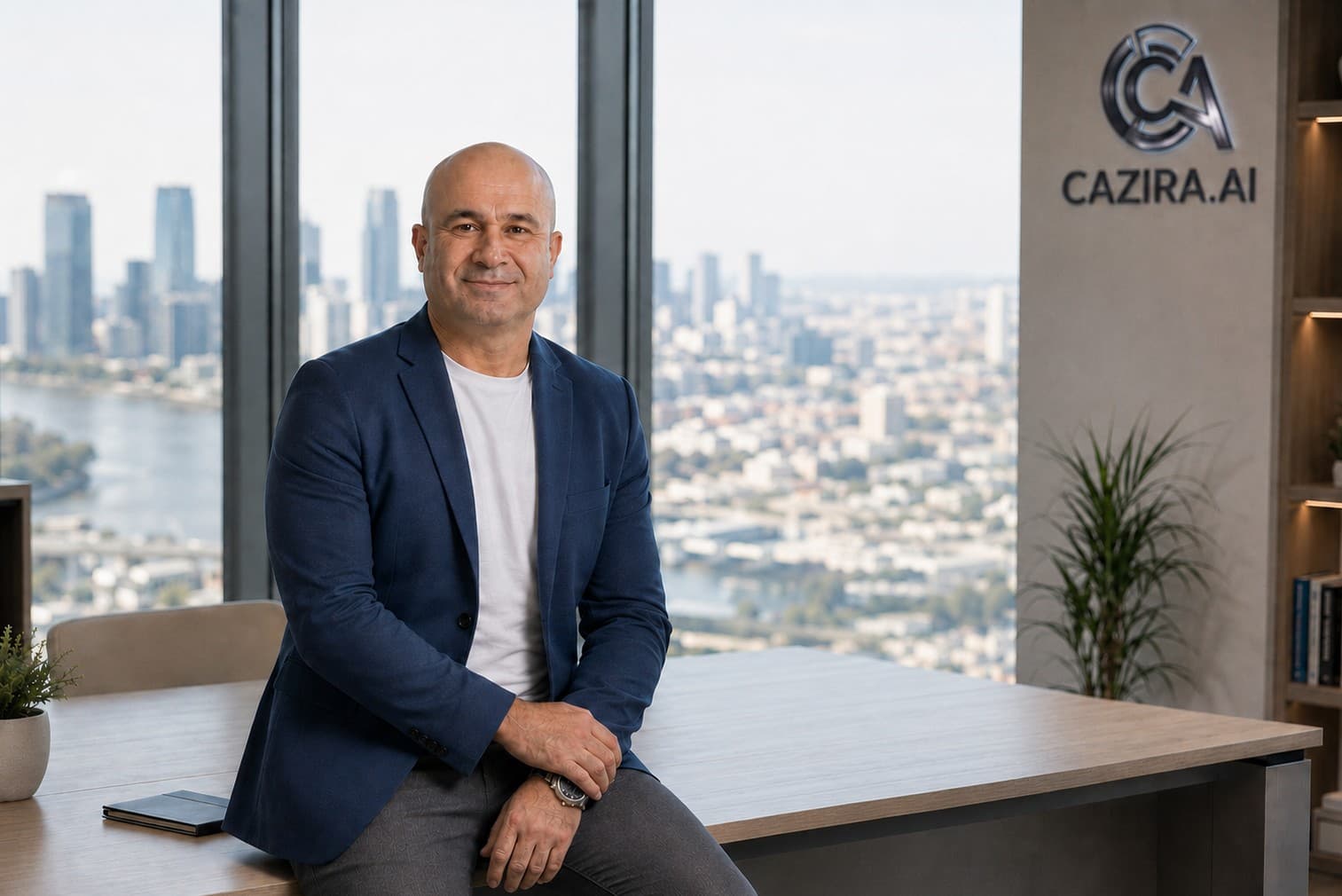
Cazira is being built as an intelligent operating layer for business — connecting the tools, workflows, knowledge and context an organisation already relies on into a shared intelligence it can actually work from.
The goal isn't another disconnected application.
It's to help the business itself become connected.
Why Cazira exists
The problem isn't a lack of software. It's a lack of connection.
Over the last decade, businesses have accumulated extraordinary technology.
CRM systems manage customers. Finance platforms manage transactions. Documents sit in cloud storage. Conversations spread across email, chat and meetings. Automation moves information between systems, analytics explains what happened, and AI assistants answer questions and perform increasingly sophisticated tasks.
Individually, many of these tools are excellent.
The problem is that the business context connecting them stays fragmented.
One system understands a customer but not yesterday's conversation. Another understands a workflow but not why a decision was made. An AI assistant may be highly capable, yet without the right memory, permissions and organisational context it still works from only part of the picture.
Cazira began with a simple question
“What would happen if the systems a business already relies on could finally share context, memory and governed intelligence?”
That question became the foundation for Cazira.
The idea isn't to abandon every tool a business already uses. It's to add an intelligent layer that connects them, understands how information and work relate, and gives AI the context it needs to become genuinely useful across the organisation.
The operating layer
Shared intelligence. Governed action.
At the centre of Cazira is something simple but powerful: shared context.
The different parts of the platform aren't designed to operate as isolated features. AI conversations, workflows, customer information, documents, analytics, meetings, integrations and future agents should work from a common understanding of the business — while still respecting who is allowed to see, decide and act.
That is where shared memory matters.
Cazira's shared-memory architecture is being designed to preserve useful business context across the platform, so authorised AI and workflows can understand more than the single interaction in front of them.
But intelligence without control isn't enough.
For businesses to depend on AI, actions also need identity, permissions, approvals, evidence, auditability and clear boundaries.
So Cazira is built around both sides of the equation: intelligence that understands more, and governance that keeps people in control.
The long-term opportunity is a business environment where information doesn't keep losing its context as it moves between systems — and where AI can help coordinate work without becoming an uncontrolled black box.
01
Shared context
Important business knowledge should not become trapped inside individual tools and isolated conversations.
02
Connected action
Intelligence becomes more valuable when it can safely connect understanding to workflows and real work.
03
Control by design
Identity, permissions, evidence, approvals and auditability should be part of the architecture, not added after the fact.
From the founder
Seeing what could exist — then working out how to make it real.
I'm George Miteff, Founder and CEO of Cazira.ai.
My path into technology hasn't been conventional.
Much of my career has been spent building businesses across different industries, studying markets and looking for opportunity where it isn't obvious.
I've always been drawn to building.
To me that means more than having an idea: understanding why something should exist, questioning whether it creates real value, working through the hard parts, and staying with a problem long enough to make it real.
I've long been fascinated by periods of major change — financial markets, investment and AI interest me because change creates both uncertainty and possibility, forcing you past how things have always been done toward what the next model could be.
The rise of AI brought a problem I'd watched in business for years into much sharper focus.
Companies could own excellent technology and still operate as disconnected parts.
They could hold more data than ever yet still struggle to keep its context, and add AI to individual applications without any real understanding of the organisation around it.
The more I looked, the more the underlying question mattered.
What if the opportunity wasn't simply another AI tool?
What if the bigger opportunity was to connect the business itself?
That thinking became Cazira.
I didn't want it to stop at an assistant that could answer questions. I wanted an operating layer that understands how the parts of a business relate to one another — while still respecting the permissions, controls and accountability real businesses require.
That is a much harder problem. It is also the one I believe is worth solving.
There is still a great deal to build, and I consider that a strength rather than something to hide.
The objective isn't to rush something into the world. It's to build something with genuine commercial value — useful, dependable and considered enough that businesses can eventually trust it as part of how they operate.
And that is the work I'm focused on now.
Vision matters. Execution is what makes it valuable.
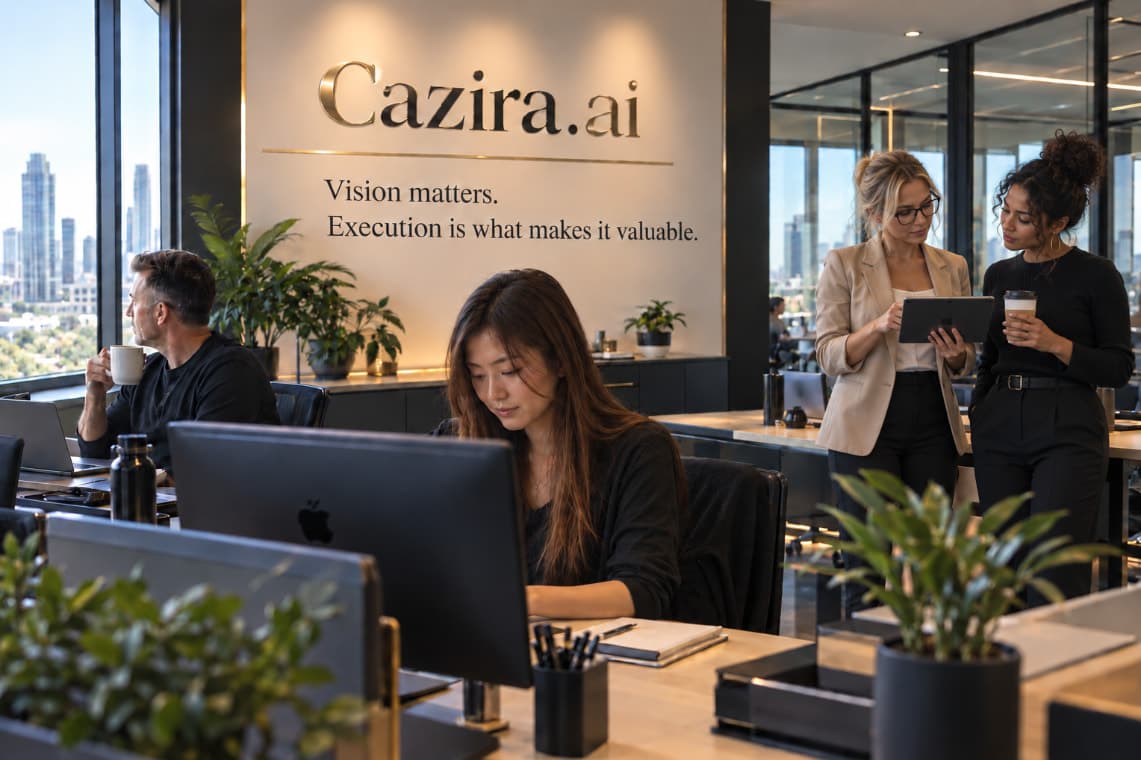

The work behind the idea
The work is in the details.
A big idea only becomes useful when the details begin to hold together.
Cazira isn't built around a single demonstration or moment of AI novelty. It is being worked through, layer by layer.
- 01How information moves.
- 02How memory should work.
- 03What an AI agent is allowed to know.
- 04What it is allowed to do.
- 05When a person should approve an action.
- 06How a decision can be traced later.
- 07What happens when something fails.
- 08How one part of the platform can understand context created elsewhere without breaking trust or security.
These aren't always the most visible parts of building a technology company. They are some of the most important.
Ideas get discussed, questioned and changed. Assumptions get tested. Architecture gets revisited. What looks straightforward on paper becomes more demanding once it has to operate safely in the real world.
Those working moments are part of Cazira's story — because building something ambitious isn't about protecting the original idea from change.
It's about making the idea stronger as reality tests it.
Building with intent
Turning vision into something real.

There is a large gap between imagining what technology could do and building something a business can actually depend on.
That gap is execution.
For Cazira, execution means deliberate choices about architecture, product design, security, permissions, reliability and the way intelligence is allowed to interact with real business operations.
It means slowing down when a foundation needs to be right, testing assumptions rather than protecting them, and going back over difficult problems when the evidence says they deserve another look.
And it means remembering that a product ultimately has to work outside the presentation.
Every major capability in Cazira is held to that standard. It shouldn't simply look impressive — it should solve a real problem, make sense as part of the wider platform, and move Cazira closer to the original goal: helping businesses operate with more shared understanding, better coordination and intelligent assistance that stays under meaningful human control.
What comes next
The ambition is large. The principle is simple.
Connect the business.
Give intelligence the context it needs.
Keep people in control.
Build something useful enough to earn trust.
Cazira is not being built to add another layer of noise to an already complicated technology environment.
The ambition is the opposite.
To make the business feel more coherent. To help knowledge keep its context. To let workflows, systems and intelligence operate from a shared understanding — and to give businesses a foundation on which increasingly capable AI can work safely and productively.
Cazira is still being built, and this story is still being written.
But the direction is clear.
Your business, finally working as one.